For the cited US 2023 Corolla 2.0 M20A-FKS manual, Toyota specifies JASO GLV-1 SAE 0W-8. It permits 0W-16 when 0W-8 is unavailable and calls for a return to 0W-8 at the next oil change. That instruction belongs to this application.

The verified application
The cited Toyota maintenance-data page identifies the 2.0-liter M20A-FKS gasoline engine and gives the 0W-8 requirement with a JASO GLV-1 oil grade. Its fallback instruction is conditional: 0W-16 can be used if 0W-8 is not available, then 0W-8 is required at the next change. This is a concrete example of a manufacturer permitting an alternative without treating the two grades as identical.
A Corolla Hybrid, a different sales market or another model year needs its own specification. A search result for “Corolla oil” can mix several applications. Confirm the engine and the manual before applying this example to a shopping decision.
Read the approval and viscosity together
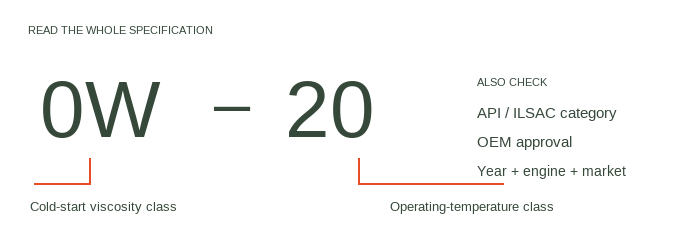
The shared 0W prefix does not erase the different operating-temperature viscosity classes. Treat the complete viscosity and the stated performance requirement as two entries on the same checklist. A jug described only as “Toyota compatible” leaves important information unresolved.
For this application, photograph the exact product label and check its stated grade and performance claim. Do not assume the API or ILSAC wording on a different 0W oil establishes JASO GLV-1 suitability. The API guide also distinguishes its gasoline-oil categories from vehicle-specific viscosity requirements.
How to document a temporary substitution
Record why the normal oil was unavailable, the product and grade actually installed, the date and odometer reading. Mark the next scheduled change with the specified return grade. This prevents an emergency or supply-related decision from becoming an undocumented permanent change.
If a shop proposes a different oil, ask it to identify the exact factory permission for your engine. “We use this in every Toyota” does not identify the applicable handbook entry. Keep its product information with the service receipt.
Use one year range only when the evidence supports it
A vehicle may retain its model name while its handbook, engine, sump or recommendation changes. A model-year directory helps locate the right car; it cannot prove oil interchangeability. Group years in a service guide only after checking the relevant documents, and separate hybrid or performance variants where the instructions differ.
- Confirm US model year and engine identification.
- Match the complete viscosity and required performance grade.
- Use a fallback only under the factory conditions that permit it.
- Measure the final level using the exact handbook procedure.
Cited 2023 Corolla 2.0 M20A-FKS example
| Item | Factory instruction | Scope |
|---|---|---|
| Normal viscosity | SAE 0W-8 | Cited US manual and engine |
| Oil grade | JASO GLV-1 | Cited application |
| Temporary alternative | 0W-16 if 0W-8 unavailable | Return to 0W-8 at next change |
Common questions
Can I permanently use 0W-16 in every 0W-8 Toyota?
This guide establishes no universal substitution. The cited Corolla instruction permits 0W-16 when 0W-8 is unavailable and requires returning to 0W-8 at the next change.
Does an oil cap settle the whole specification?
The cap can identify a viscosity, but the manual provides the application, performance requirement, measuring procedure and any permitted alternative. Keep those details together.
