The cited 2019 Rogue SV 2.5L catalog lists filter 15208-65F0E. The matching non-hybrid owner manual specifies a new drain washer and separate tightening ranges for the filter and drain plug.
Nissan Rogue
US 2019 Rogue non-hybrid manual; filter number checked in SV 2.5 L factory catalog.
| Item | Value | Application / source |
|---|---|---|
| Catalog oil filter | 15208-65F0E | 2019 Rogue SV 2.5 L selected catalog applicationFactory source ↗ |
| Filter tightening range | 14.7–20.6 N·m | 2019 non-hybrid owner manual oil-change procedureFactory source ↗ |
| Drain-plug tightening range | 29–39 N·m with new washer | 2019 non-hybrid owner manual oil-change procedureFactory source ↗ |

The catalog and manual answer different questions
The selected official SV 2.5-liter parts page lists engine oil filter 15208-65F0E. Confirm the current VIN application before buying. The linked owner manual provides the installation and post-service checks; a parts number does not replace those instructions.
This is the 2019 Rogue non-hybrid application. Rogue Sport, Rogue Hybrid and later Rogue engine families require their own documents. Keep that distinction on a service kit order, especially where a retailer groups several Nissan model names together in its search results.
Keep the filter and drain-plug settings separate
The manual's engine-oil service section lists a filter tightening range of 14.7–20.6 N·m and a drain-plug range of 29–39 N·m, with a new washer on the drain plug. These settings apply to the cited procedure and must not be mixed up with wheel-fastener values or a different engine's drain hardware.
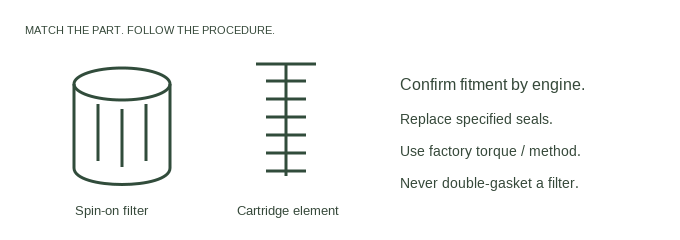
Inspect the filter mounting surface for the old gasket before installing a replacement. A second gasket left behind can cause a fresh service leak. The washer is a separate sealing item; the filter gasket and drain washer do different jobs and should not be treated as one reusable seal.
Use the post-service check, not a generic wait
After the service leak inspection and shutdown, the cited procedure waits more than fifteen minutes before the final dipstick check. Its routine oil-level section uses a different wait. Follow the section appropriate to the task instead of assuming every engine-oil check has the same timing.
Arrange safe support and the correct lifting points before starting, and protect against hot oil. If the plug, pan or threads are damaged or differ from the documented arrangement, stop and obtain the correct repair information. More tightening force is not a reliable repair for a damaged sealing surface.
Keep the parts record useful
Save the exact catalog application, supplied part number and installation information with the service record. A superseded number, replaced housing or uncertain engine application deserves a fresh VIN-based check before the next order.
- Confirm the engine, model year and stated trim scope before ordering.
- Match the physical replacement and sealing arrangement before discarding the old part.
- Follow the applicable installation method; do not reuse a removal-force estimate as a tightening setting.
- Record the actual parts supplied and verify the final level and sealing points.
Verified parts and procedure reference
| Item | Factory reference | Application / limit |
|---|---|---|
| Oil filter | 15208-65F0E | Selected SV 2.5 L catalog application |
| Filter tightening range | 14.7–20.6 N·m | Cited 2019 non-hybrid manual procedure |
| Drain plug with new washer | 29–39 N·m | Cited 2019 non-hybrid manual procedure |
| Post-service final check | Wait more than 15 minutes after shutdown | Use the service section, not the routine-check shortcut |
Common questions
Does a similar-looking filter prove that it fits?
No. A physical resemblance is not proof of the correct application or sealing arrangement. Use the selected factory catalog or filter manufacturer’s application listing and resolve any VIN, engine or production-date qualification before installation.
Can I apply this information to another model year?
Only the listed year and application were checked here. A shared model name or part pictured on a broad catalog page does not verify other years. Keep unverified applications separate until their own documentation has been checked.

