Use the engine’s specified grade and any permitted substitution instructions. A mixture of two viscosity grades is not a certified new grade that can be calculated with simple arithmetic. Mixing also leaves uncertainty about the complete performance and approval claims.

Do not invent a middle grade
The label reflects defined test classifications, not a simple linear thickness scale. Combining equal quantities of two labeled oils does not let you name or certify the result. Their formulations and viscosity behavior can differ beyond the printed numbers. A home average is not equivalent to a tested product.
Read the vehicle’s exceptions
Some engines allow a temporary alternative grade under particular circumstances. Apply the actual wording and any follow-up instruction. Another model’s allowance is not evidence for yours. If the preferred oil is available, use it rather than blending leftover containers to create a supposed improvement.
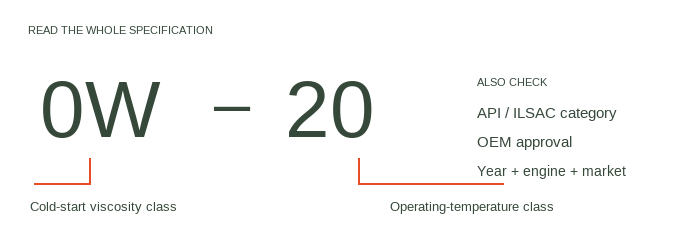
Keep top-ups controlled
A low reading should first be confirmed on level ground using the prescribed method. Add only the amount needed, not an entire bottle because a substitute is already open. Record the exact product, grade and quantity. If a wrong fluid or clearly unsuitable oil was added, seek appropriate correction guidance before continued use.
- Do not average grade numbers.
- Match approvals as well as viscosity.
- Use only documented alternate-grade allowances.
- Keep the original service history accurate.
Use leftovers responsibly
Clearly label and store usable oil in its original container, and reserve it for a compatible application within the maker’s storage guidance. Do not empty miscellaneous leftovers into one bottle and then treat the contents as a known product. Unknown mixtures are difficult to evaluate and make later maintenance decisions less reliable.
Common questions
Does mixing 0W-20 and 5W-30 make 2.5W-25?
No. That is not a valid certified grade calculation.
Can I keep a bottle of mixed leftovers for emergencies?
Keep known, suitable products instead. An unknown mixture removes useful specification information.
Does a small top-up erase the old oil’s age?
No. Keep the original oil and filter service date and record the addition separately. The amount added is useful maintenance information, but it is not a new full-service baseline.