A filtration percentage is incomplete without the particle size, test method and applicable part information. Compare suitable filters using equivalent evidence. A finer-sounding micron number alone does not prove better overall performance for your engine.

Read the complete efficiency statement
Look for the percentage, particle size and test conditions together. A statement about particles above a particular size should not be compared casually with a different claim at another size. Check whether the result applies to the exact filter part or a representative sample of a product line.
Keep capacity and flow in the comparison
Efficiency describes one aspect of filtration. Service capacity, restriction and application design also matter. A racing product may prioritize different operating needs from an ordinary road-car filter. Do not select a filter solely because one number looks strongest while ignoring its intended use and service limits.
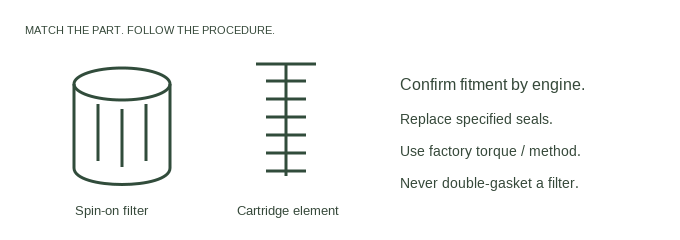
Start with correct fitment
Only compare products actually listed for the engine. An unsuitable filter with an impressive efficiency claim is still unsuitable. Catalog fitment includes more than outer dimensions or thread size. If a retailer gives vague numbers without a source, ask the filter maker for current part-specific technical information.
- Match test size and method where possible.
- Read representative-part footnotes.
- Check service capacity and interval conditions.
- Confirm exact engine fitment before comparison.
Avoid turning numbers into a ranking you cannot support
Without equivalent test data, state the limits of the comparison. Do not claim a product was independently tested when you have only a maker’s specification. For a DIY purchase, a correctly specified filter from a traceable supplier, installed properly and changed on schedule, is a more useful standard than an unsupported league table.
Common questions
Does 99% efficiency mean all particles are removed?
No. Read the stated particle size, test method and conditions.
Is the smallest micron claim always best?
Not by itself. Fitment, flow, capacity and the complete application matter.
What if two makers use different tests?
State that the figures are not directly comparable unless equivalent conditions are established. Do not create a numerical winner from unlike claims or imply independent testing that has not been performed.