Both oils have an SAE 20 high-temperature viscosity grade, but their low-temperature classifications differ. That shared second number does not make them universally interchangeable. Check the exact engine’s allowed grades and required performance specification.

Understand what stays the same
The second number places both products in the same high-temperature viscosity grade. It does not mean their formulations, approvals or measured properties are identical. The W classifications establish different low-temperature performance requirements. Avoid describing the grade as a pair of weather temperatures.
Use the actual alternate-grade rule
A manual may allow 5W-20 in place of 0W-20 under a defined availability condition, but another engine may not. Read the wording and any next-service instruction. An internet discussion about an older model is not sufficient evidence for a different engine or market.
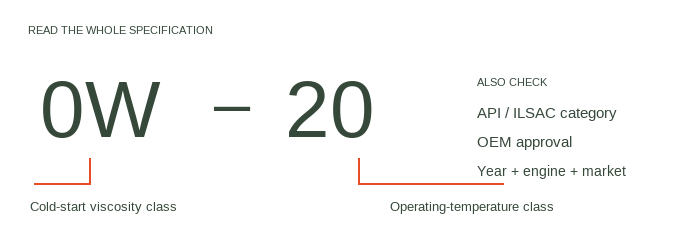
Compare the whole bottle
Look for the required API or ILSAC category and any manufacturer approval on the exact viscosity variant. A product family may list several grades with different specifications. Brand familiarity does not remove that check. Keep the product data current when buying online, where photos may show an earlier label.
- Identify the specified preferred grade.
- Check whether the alternate is actually allowed.
- Match performance requirements as well as viscosity.
- Keep a note of the oil added.
Make a practical purchase decision
When both grades are explicitly permitted and meet the full specification, select within those instructions rather than chasing a claimed universal winner. Retain the normal service interval and verify the oil level after the work. If the preferred product is unavailable, consult the permitted alternative before making an unsupported substitution.
Common questions
Are both oils SAE 20 when hot?
They share that high-temperature viscosity classification, while their other properties and approvals can differ.
Can I mix them for a top-up?
Follow the vehicle’s grade and emergency-substitution instructions. A mixture is not a newly approved product.
Can I decide using bottle price alone?
Compare only products that satisfy the engine’s complete requirement and any alternate-grade conditions. The cheaper grade is not an equivalent service choice if the vehicle does not permit it.