0W-20 and 5W-30 have different low-temperature classifications and different high-temperature viscosity grades. Use the grade allowed for your exact engine. Neither is universally better, and a climate preference cannot replace the required approval.

Read both halves of the grade
The W classification concerns low-temperature performance; the second number concerns a separate high-temperature viscosity classification. The numbers are not ambient-temperature limits or a simple thickness score. In this comparison both parts change, so it is inaccurate to describe the choice as only a winter-starting difference.
Check the manufacturer’s permitted choices
Some engines specify one grade, while others allow alternatives under stated conditions. Read the exact engine and market instructions. Do not use another model’s allowance as proof that substitution is safe. A temporary availability exception, where present, may include a requirement to return to the preferred grade.
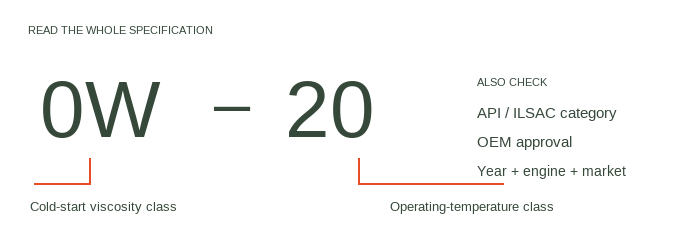
Keep specification and viscosity together
A 5W-30 carrying a different approval is not equivalent to a required 0W-20 simply because both are synthetic. Identify the engine’s API, ILSAC, ACEA or manufacturer requirement and match it alongside the grade. Two products with identical viscosity numbers can also differ in their approved applications.
- Confirm the exact engine.
- Read any allowed alternate-grade conditions.
- Match the required performance approval.
- Record any temporary top-up substitution.
Avoid using viscosity as a repair
Moving to the thicker high-temperature grade is not a diagnosis for noise, consumption or low pressure. A symptom needs investigation, and an unauthorized grade can obscure the maintenance history. If the wrong grade was installed, compare the actual product with the engine requirement and seek vehicle-specific correction guidance.
Common questions
Can I use 5W-30 because the engine is old?
Mileage alone does not authorize changing the specified grade.
Will 0W-20 be too thin in summer?
Use it when specified for the engine and conditions. The grade is designed and approved as a complete multigrade oil.
What should I ask a shop after a suspected wrong fill?
Ask which exact product and grade were installed, then request the evidence that they meet the engine’s requirement. Use the invoice and current product data rather than a general reassurance about the brand.