ACEA categories describe different engine-oil performance applications. They are not a ladder where a higher-looking code is automatically a substitute. Match the full category, viscosity and manufacturer approval required by the exact engine.

Keep the complete code intact
When copying the requirement, retain the letters, number and any relevant edition or approval wording. Shortening the requirement to European oil or diesel oil discards important information. A product that matches viscosity but carries another ACEA category may be formulated for a different application.
Read categories with the engine’s needs
Aftertreatment compatibility and viscosity-related performance requirements can differ between categories. Do not choose an oil solely because it says low ash, fuel economy or long life. Those descriptions are not universal compatibility rules. The manufacturer’s instructions determine which complete product belongs in the engine.
Use current product evidence
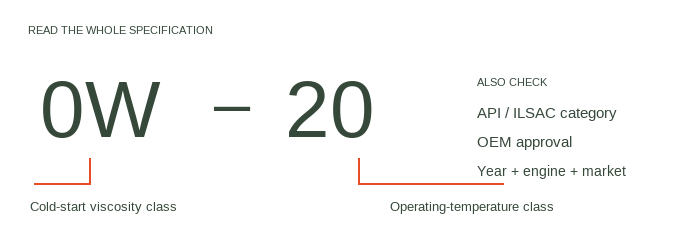
Check the exact oil variant’s current data sheet and approval claims. Different grades in one brand family can carry different ACEA categories. A retailer may show a generic image that belongs to another grade or an earlier formulation. Resolve that mismatch before buying rather than assuming the name guarantees the same application.
- Copy the full vehicle requirement.
- Match viscosity and category together.
- Check any formal manufacturer approval.
- Avoid substituting a higher-looking code by guesswork.
When several oils appear to qualify
Compare only products that satisfy every required item. Price, availability and packaging can then guide the purchase. If the manual permits more than one category under different conditions, apply those conditions accurately. Ask the vehicle or oil manufacturer when an apparent successor category or dual claim is unclear; do not invent a cross-reference.
Common questions
Is C3 always better than C2?
They are different application categories, not a universal quality ranking.
Does an ACEA claim replace an OEM approval?
Not when the engine separately requires that manufacturer approval.
Can two products list more than one category?
Yes, but evaluate their actual current claims rather than inventing a universal cross-reference. The exact engine approval and viscosity still need to match, and ambiguous application wording should be checked with the maker.