A formal manufacturer approval and a marketer’s suitability statement are different kinds of evidence. Read the vehicle’s exact requirement and the current oil data sheet. Where an approval is required, verify the precise product and viscosity rather than relying on similar wording.

Copy the vehicle requirement exactly
An approval code may include numbers or suffixes that distinguish different applications. A similar-looking code is not necessarily interchangeable. Keep the complete requirement with the engine and market details so you do not shop from memory. Viscosity remains a separate requirement to check.
Read the wording around the code
Oil data sheets can distinguish approvals, specifications met, recommendations and suitability claims. These headings matter. A product may be formally approved for one code and recommended by its marketer for another. Do not merge all codes into a single approved list simply because they appear on the same page.
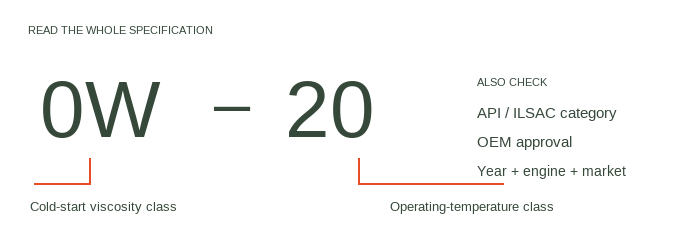
Verify the exact product variant
Check that the evidence belongs to the same viscosity and product name you are buying. Formulations can differ across regions and change over time. Where a manufacturer offers an approval list, compare against it or request confirmation from the responsible company. A retailer’s short description may omit the distinction.
- Retain the complete approval code.
- Read approval and recommendation headings.
- Check the exact grade and market product.
- Keep a current data-sheet copy with the service record.
Resolve ambiguity before a planned service
If a seller cannot show how the oil matches the requirement, choose a product with clear evidence or ask the manufacturer. Do not let a low price or premium branding override the missing information. In an emergency, apply the vehicle’s stated substitution guidance and document it; a temporary exception is not a permanent approval.
Common questions
Is “recommended for” always false?
No. It is a different claim from a formal approval and should be evaluated according to the vehicle’s requirement.
Does the same viscosity prove an approval match?
No. Viscosity and approval describe different requirements.