Use the refill and air-purge procedure for the cooling-system layout. Bleed screws, vacuum filling, electric-pump routines and scan-tool steps can make a generic “run it with the cap off” method unsuitable.

Establish why air may be present
Air can remain after cooling-system service or enter when the system loses coolant. Note what was opened, replaced or drained and whether the level has fallen again. Gurgling, changing heater output or an unstable temperature reading can guide investigation, but those observations do not prove air is the only fault.
Stop if the vehicle overheats or loses coolant. A purge procedure cannot repair a leaking hose, failed component or internal gas-entry problem. Find and resolve the loss path before repeatedly refilling the system and trying another universal bleeding trick.
Prepare the procedure before opening the system
Identify the fill location, supported coolant, service quantity and any required tools. Determine whether the process uses bleed points, a vacuum-fill device, an electric-pump sequence or diagnostic equipment. Keep the full sequence available, including how the final level is checked after cooling.
Gates’ water-pump instructions specifically direct use of the vehicle manufacturer’s purge procedure after filling. Prestone’s fill guidance also starts with a cold system. Those requirements matter because trapped air is a system-layout problem, not simply a matter of waiting for bubbles to stop in an open bottle.
Verify the result after cooling
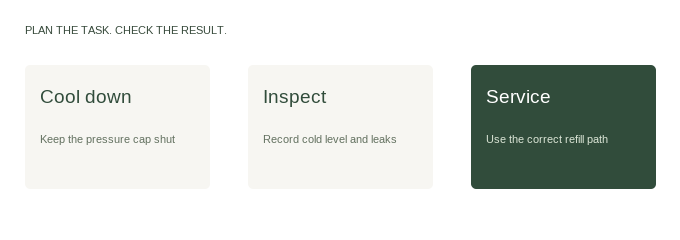
Follow the specified operating and cooling sequence without opening a hot pressure cap. Record the final cold level, heater performance where relevant, temperature behavior and any visible leakage. Use the correct reference marks; a hot expansion level and the next morning’s cold level can differ.
If the same symptoms recur, preserve the service notes and ask for further testing. Do not keep adding coolant indefinitely without finding where it goes. A successful refill includes stable operation and a controlled final level, not only the disappearance of visible bubbles during one stage.
Collect these details before refilling
| Required detail | Reason |
|---|---|
| Fill and bleed locations | Controls where coolant and air move |
| Coolant specification | Keeps the correct fluid in the system |
| Tools or pump routine | Determines whether the process is supported at home |
| Final cold-level check | Verifies the completed refill |
Common questions
Should every car be run with the cap off to bleed air?
No. The supported purge process depends on the cooling-system design and can require specific tools or control routines.
Can bleeding fix a repeated coolant leak?
The source of the loss must be repaired. Air removal does not seal a leaking component.