If bubbling comes with overheating, steam or coolant loss, stop safely and let the system cool. Bubbles alone do not identify a failed head gasket or justify opening a hot pressure cap.

Respond to the temperature condition first
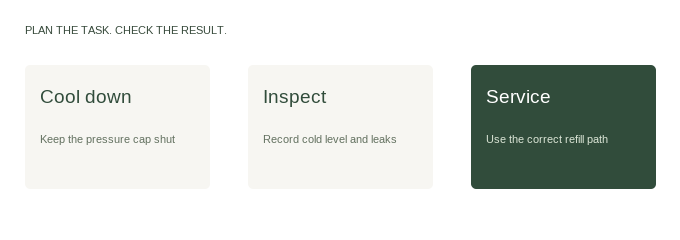
Move to a safe place when the temperature warning rises, steam appears or the vehicle indicates overheating. Follow the shutdown guidance for that condition and keep away from the pressure cap. Opening a hot cooling system can release scalding coolant. Do not continue driving to see whether another burst of airflow makes the warning go away.
Once everything is cold, note the reservoir level and look for visible wet areas without reaching near fans or belts. Record what happened before the symptom: recent cooling-system work, a top-up, heavy traffic, towing or air-conditioning use. Those details help distinguish several paths that can produce a similar bubbling observation.
Separate air, boiling and combustion gas
A reservoir can show moving air or gas for different reasons. Haynes discusses trapped air, pressure loss, poor circulation and combustion-gas concerns among the possibilities. None can be confirmed from a short video of bubbles alone. A leak, cap problem or recent refill can change system behavior without proving an internal engine failure.
Repeated coolant loss, rapid pressure buildup or bubbling associated with overheating calls for proper testing. A technician may need a pressure test, cap test, gas test or circulation assessment. Ask what result supports the diagnosis before authorizing a major engine repair or pouring in a sealing additive.
Keep the next service focused
Retain photographs of the cold level and visible leakage, along with the warning message and driving conditions. Do not repeatedly add random coolant mixtures to make the reservoir look full. The specification, concentration, refill process and reason for the loss need to remain connected.
After repair, ask how the system was refilled, purged and checked under operating conditions. Recheck the cold level as directed and report a recurring loss. A temporary disappearance of bubbles after a top-up is not enough evidence that the original problem has been resolved.
Record the observation before buying parts
| Observation | Useful follow-up |
|---|---|
| After recent coolant work | Check refill and purge completion |
| With steam or warning | Stop and assess overheating |
| Repeated cold-level loss | Locate leakage or another loss path |
| Persistent gas concern | Request appropriate diagnostic testing |
Common questions
Do bubbles always mean a bad head gasket?
No. Air, boiling, pressure loss and other circulation problems can produce bubbling. Testing must identify the cause.
Can I open the cap to let the bubbles out?
Do not open a hot or pressurized system. Allow it to cool and use the correct service procedure.