Blue or blue-gray exhaust can be a clue that oil is entering combustion, but appearance depends on light, temperature, and after-treatment. Record when the smoke occurs and whether the oil level is falling. Heavy smoke, poor running, or a warning needs prompt assessment rather than a guess at the failed part.

Observe the timing without staging a test drive
Note whether smoke appears at a cold start, after idling, during ordinary acceleration, or after a period of deceleration. A short video from a safe position may help the technician, but do not repeatedly rev a stationary engine or follow closely behind another car to film it. Confirm that smoke exits the tailpipe rather than rising from oil on the outside of the engine. Those observations point toward different inspections.
Pair the smoke report with a level log
Check engine oil consistently using the manual's procedure and record measured additions. Look for external leakage from above with the engine cool, and note coolant loss, fault codes, and recent repairs. Color alone cannot separate worn valve seals, piston-ring problems, crankcase-ventilation faults, or turbocharger-related oil entry. A recently overfilled engine also changes the diagnostic starting point. An absence of visible blue smoke does not rule out consumption.
Ask for evidence before a major repair
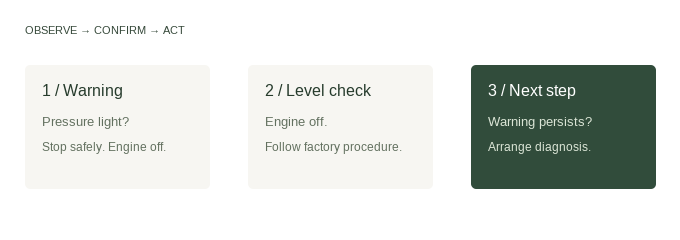
A technician may inspect intake and ventilation components, examine spark plugs, and perform engine-specific tests when appropriate. Ask which observations support the proposed repair and which competing causes have been ruled out. Do not use a thicker oil or smoke-suppressing product to conceal the symptom before an inspection. If smoke becomes suddenly heavy, the engine runs roughly, or the pressure warning appears, stop safely and arrange assistance.
- Record cold versus warm operation.
- Document oil additions and mileage.
- Identify tailpipe smoke versus engine-bay smoke.
- Share recent oil fill and repair history.
Common questions
Does smoke only at start-up prove valve seals?
No. That pattern can guide diagnosis, but it does not by itself confirm the component responsible.
Will an oil change fix blue smoke?
Fresh oil may be due for maintenance, but persistent smoke still needs a cause-based diagnosis.