Falling engine-oil level can result from an external leak, oil entering the combustion process, or an inconsistent measurement. Establish a repeatable level and top-up log first. Smoke patterns and spark-plug findings can help a technician narrow the cause, but they do not prove a particular repair.

Build a useful consumption record
Begin with the correct oil in the permitted level range. Use the same parking location and the manual's temperature and waiting conditions for each reading. Record the odometer and the exact amount added; a photograph of a partly used bottle is less useful than a measured quantity. Check more frequently until you understand the rate. Never deliberately let the level fall below the minimum to finish an experiment or consumption test.
Look for evidence beyond the exhaust
A leaking engine can lose oil without leaving a large puddle because an undertray catches it or heat burns it away. Inspect accessible areas with the engine off and cool. Note whether visible exhaust smoke occurs on start-up, during acceleration, or after deceleration, and whether there are fault codes or poor running. Catalytic after-treatment can make visible smoke an unreliable measure. Crankcase ventilation, turbocharger plumbing, and internal engine condition may all enter the diagnosis.
Use the evidence to plan a diagnosis
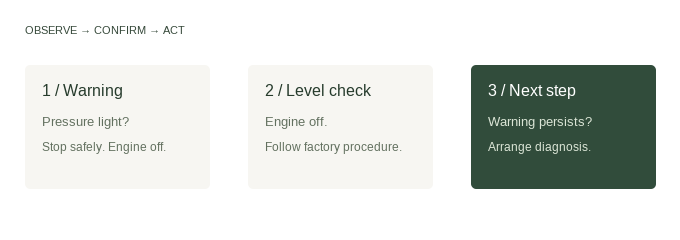
Ask for the manufacturer's procedure and any applicable service information for the exact engine. A workshop may inspect the ventilation system, check for leaks, examine plugs, and perform compression, leak-down, or other tests when justified. Changing viscosity or adding a treatment can obscure the baseline without fixing the cause. Sudden heavy smoke, a major level drop, overheating, or an oil-pressure warning needs a prompt stop and assessment.
- Measure added oil, distance, and dates.
- Record towing, idling, and unusual loads.
- Keep oil specification and service receipts.
- Ask for the measured results behind a proposed engine repair.
Common questions
Is any oil consumption normal?
Some engines consume oil in service, but acceptable limits and test procedures are engine-specific. A sudden change deserves investigation.
Does blue smoke always mean piston rings?
No. Oil can enter combustion through several routes. Smoke is a clue to investigate, not a parts-ordering instruction.