Repeated journeys that do not bring the engine through normal operating conditions can be relevant to moisture or fuel accumulation and severe-service schedules. Follow the exact manual's maintenance rules. A rising level, persistent strong fuel odor, or widespread milky oil still needs diagnosis rather than an assumed driving cure.

Describe your real use pattern
Count cold starts, brief school or shop runs, idling, seasonal cold, and how often a normal longer journey occurs. Distance alone may not describe the operating pattern. Find the severe or special operating conditions in the manual for the exact engine and market. Do not borrow another vehicle's shorter interval as a universal rule. Oil-life systems and time limits may need to be considered together according to the manufacturer.
Monitor the useful changes
Check the level under consistent conditions and record whether it rises or falls. A small deposit under the cap is different from milky oil on the dipstick; note both accurately. Track a persistent fuel-like odor without deliberately inhaling vapors. Short journeys can provide context, but they do not rule out fuel-system or cooling-system faults. Report rough starting, fault codes, coolant loss, and overheating to the workshop.
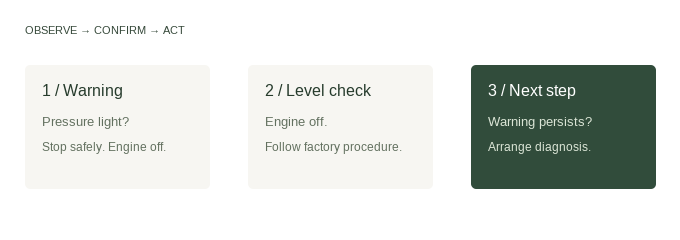
Choose maintenance instead of a forced remedy
Use the required oil and filter, follow the appropriate schedule, and retain service records. If your use changes, review which schedule applies. Do not idle for a long period as an oil-cleaning strategy or drive a suspected faulty engine simply to warm it thoroughly. When a persistent contamination symptom exists, ask for a diagnosis and an oil-service plan that addresses the cause, not just a change of driving habits.
- Review the severe-service definition in your manual.
- Record cold starts and short-trip frequency.
- Monitor level and coolant trends.
- Assess persistent contamination symptoms separately.
Common questions
Does a weekly long drive guarantee clean oil?
No. It does not replace the schedule or diagnose a mechanical source of contamination.
Should I change oil solely by mileage?
Use all applicable manufacturer criteria, including time, operating conditions, and any specified oil-life system instructions.