Choose oil that meets the vehicle’s required specification and viscosity. Synthetic formulations can offer advantages under demanding temperature and oxidation conditions, but the word synthetic alone does not prove approval or authorize a longer service interval.

Compare complete products
Conventional, blend and full-synthetic descriptions concern the formulation approach, not the complete engine compatibility. Start with the manufacturer’s required approval and grade. If the engine explicitly requires synthetic oil or a specification only available in suitable synthetic products, a cheaper conventional oil is not an equivalent choice.
Understand the practical difference
Base oils and additive packages both influence performance. Synthetic formulations can be designed to perform well in demanding temperature conditions and resist degradation, but different products still have different claims. Compare current data for the exact product rather than assuming all synthetic bottles are identical or all conventional oils are unsuitable for every older engine.
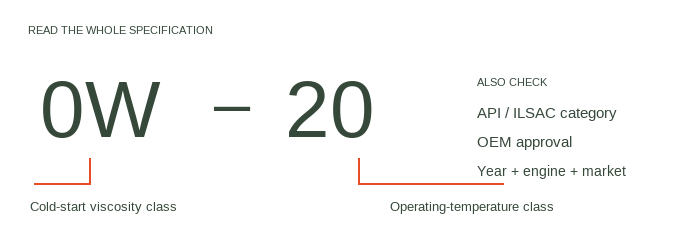
Compare service cost fairly
Use the quantity your engine actually needs and include the correct filter. Retain the manufacturer’s interval unless a specific approved program says otherwise. A more expensive oil can be the required choice; a premium marketing label is not automatically necessary when several compliant products meet the same application.
- Required approval first.
- Correct viscosity second.
- Compare the exact product’s claims.
- Apply the vehicle’s service limits.
Choose around the application
Cold starts, heavy load or a turbocharged engine may make particular performance requirements important, but those conditions do not replace the manual. Switching product types should not become a reason to add flushing chemicals or disregard an existing leak. Document the selected oil so future top-ups and services remain consistent.
Common questions
Can synthetic oil fix engine wear?
It is a lubricant choice, not a repair for mechanical damage.
Does synthetic always mean twice the interval?
No. Use the manufacturer’s schedule and any applicable oil-life guidance.
Can I compare oils by warranty distance alone?
Read every condition attached to that claim, including time limits, approved applications and maintenance requirements. Compare products only after confirming that they meet the engine’s required viscosity and approval.
