Compare the exact oil approval, viscosity and current product data. A blend contains a formulation sold as a synthetic blend, while a full synthetic uses a different formulation approach; the marketing terms alone do not tell you which bottle meets your engine’s requirement.

Start with the requirement you must meet
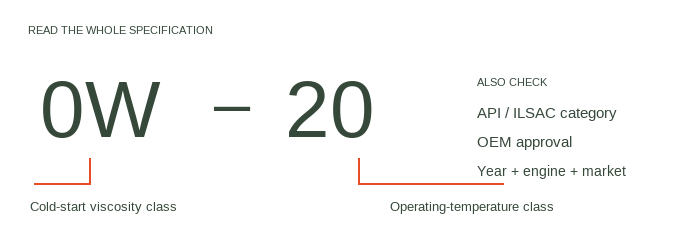
If the vehicle requires a particular manufacturer approval, locate it on the product data or approval information. A bottle described as full synthetic can still be wrong for that engine. Conversely, a suitable blend may be acceptable when the vehicle permits it and the complete specification matches.
Do not invent a synthetic percentage
The word blend does not give you a universal percentage to calculate from. Product makers use different formulations and descriptions. Compare documented performance claims rather than guessing how much synthetic base oil is inside. The additive system also matters; a base-oil label is not a complete performance report.
Keep the interval comparison controlled
A full synthetic label does not automatically create an extended service interval, and a blend label does not establish a universal short interval. Use the vehicle schedule, operating conditions and required oil specification. When comparing purchase cost, include the real quantity and filter rather than an assumed standard-size service.
- Check the exact viscosity variant.
- Read current approvals and limitations.
- Compare total service cost.
- Retain the engine’s time and distance limits.
Make switching a simple documented service
A routine switch between compliant products generally should not become a home experiment in flushing or additives. Follow the manufacturer’s procedure, fit the correct filter and verify the level. Keep the label information so another person can buy a compatible top-up later. If there is an existing mechanical concern, assess it separately.
Common questions
Is a blend always half synthetic?
No universal percentage follows from the label.
Is full synthetic always the correct choice?
Only a product meeting the engine’s full requirement is an appropriate choice.
Does the same brand guarantee matching approvals?
No. Read the exact grade and current data sheet for each product. A blend and full-synthetic variant can have different application claims even when their front labels look closely related.