VW 502 00 and VW 508 00 are different oil requirements. A US 2019 Golf-family service chart assigns them to different engines, demonstrating why a model name or shared turbo badge is insufficient for choosing oil.

A verified same-year example
Volkswagen of America’s 2019 ServiceXpress chart distinguishes the 1.4-liter DGXA, 1.8-liter CXBA/CXBB and 2.0-liter DKFA applications. It lists VW 508 00 with SAE 0W-20 for the cited DGXA and DKFA entries, and VW 502 00 with SAE 5W-40 for the cited 1.8-liter entries.
These are examples from one official chart, not a specification for every Golf, GTI or Alltrack ever sold. The engine code is a useful filter because a model year can contain multiple engines, and a familiar badge can outlive the original powertrain.
Why the common brand name is misleading
A product marketed for European vehicles may carry several approvals. Read the exact approval and viscosity on the specific product rather than assuming that “Euro,” “synthetic” or a familiar brand establishes suitability. The correct row in a multi-grade data sheet matters as much as the front label.
Do not treat the larger approval number as permission to substitute it everywhere. A specification belongs to an application. The buyer’s task is to match the requirement, not to invent an approval hierarchy based on numbering.
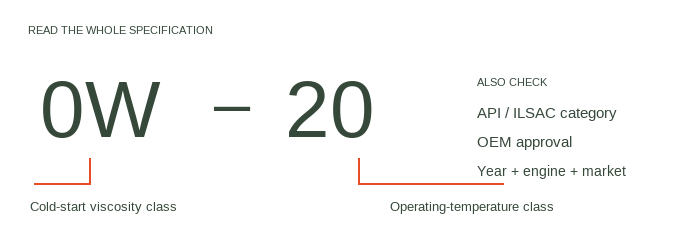
Use a source that matches the actual vehicle
Record the VIN, model year, engine code and sales market before gathering service information. Use the matching factory manual or current service reference; if a bulletin revises an earlier chart, keep its date and exact application with the research.
An oil cap can help identify the expected viscosity but may not supply the complete approval, refill amount or replacement-part detail. Confirm those separately. Avoid treating a chart for a neighboring model year as a proven year range unless the supporting documents actually cover both years.
Make a parts-counter note that prevents mistakes
Write the engine code beside the required approval and grade. Add the service-fill quantity, filter and seal information only from their own verified entries. When a shop quotes “VW-approved synthetic,” ask it to identify which approval and exact product it will install.
After service, retain the product identity and recheck the level under the manual’s conditions. If a wrong product has already been added, record the amount and exact bottle and obtain application-specific advice. A speculative internet mixture ratio is not an equivalent approval.
- Match model year and engine code.
- Read the complete VW approval and SAE grade.
- Check for superseding factory information.
- Confirm the service quantity and level-check method independently.
Examples from the cited US 2019 ServiceXpress chart
| Engine entry | Approval | Listed viscosity |
|---|---|---|
| 1.4L DGXA | VW 508 00 | SAE 0W-20 |
| 1.8L CXBA / CXBB | VW 502 00 | SAE 5W-40 |
| 2.0L GTI DKFA | VW 508 00 | SAE 0W-20 |
Common questions
Can all 2019 Golf-family cars use the same 0W-20 oil?
The cited US chart contains different engine-specific entries. Use the exact engine code and current applicable documentation.
Does a bottle approved to VW 502 00 also meet VW 508 00?
Do not infer another approval. Check the precise product’s documented approvals and the requirement for your engine.
