An overheating engine needs immediate attention even if switching off the A/C lowers the temperature. Record the driving pattern and inspect the cooling system rather than treating A/C use as the repair.

Record the pattern without recreating the failure
Note whether overheating happens only at a stop, during slow traffic, at highway speed or on a long climb. Record the outside conditions and whether the A/C was cooling normally before the temperature rose. Do not deliberately idle an already overheating engine to produce a clearer video.
Stop safely when a warning, steam or abnormal temperature appears and use the vehicle’s response procedure. Keep the cap closed while the system is hot. Waiting for a safe cold inspection is more useful than adding fluid into a dangerously hot system just to continue the journey.
Think about heat rejection and airflow
The engine’s cooling system has to reject heat, and A/C operation can change the load and airflow conditions at the front of the vehicle. A symptom that is worse at low road speed can make fan operation and blocked airflow relevant checks. That pattern still does not prove a fan motor has failed.
Low coolant, leakage, circulation problems, a thermostat fault or an inaccurate temperature signal can also matter. Haynes identifies coolant quantity, air pockets, thermostats and fans as separate temperature-warning investigation paths. Keep them separate rather than replacing every component associated with heat.
Request a test-based repair
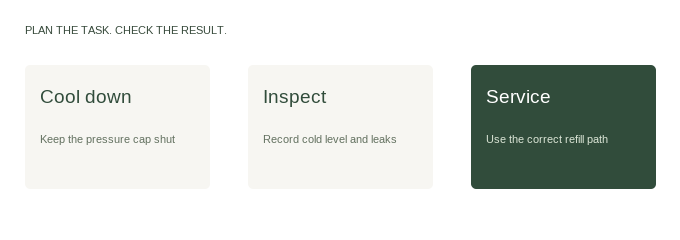
When cold, note the level and visible leakage and look for obvious debris at accessible air inlets. Keep fingers and tools away from fans, which can start unexpectedly. Do not bridge relays or bypass a control system to force a result.
Give the workshop the conditions under which the symptom appears and ask it to verify fan command, fan operation and cooling-system integrity as applicable. After repair, ask how the original operating condition was checked. A/C turned off for the final road test does not demonstrate that an A/C-related overheating pattern has been resolved.
Describe the operating pattern
| Pattern | Investigation clue |
|---|---|
| Hot mainly at low road speed | Airflow and fan-control checks |
| Hot at several road speeds | Broader level and circulation assessment |
| After cooling-system work | Refill, trapped air and leakage checks |
Common questions
Does switching off the A/C fix the cause?
It can change operating load, but the original overheating condition still needs investigation.
Should I replace the fan immediately?
Confirm the fan command, power, control and actual operation. A stopped fan at one moment is not a complete diagnosis.
