New knocking or heavy rattling together with low oil or a pressure warning requires a safe stop and engine shutdown. Restoring the level does not prove that damage was avoided or that pressure is normal. Arrange an inspection before further running when the sound or warning remains unexplained.

Do not use engine speed as a test
It is tempting to rev the engine to see whether the noise clears, but additional running may worsen a lubrication problem. Pull over safely, switch off, and record the warning text and operating conditions. Do not restart repeatedly to capture a better video. Different sounds can come from accessories, combustion, timing components, or internal wear, and a phone recording rarely identifies the source reliably without other checks.
Check the oil after shutdown
When it is safe and components have cooled, use the exact manual procedure to obtain a level reading. Note whether oil is visible and whether fresh leakage is present. A correct-specification top-up may restore a low level, but it cannot reverse wear or establish that oil is circulating correctly. Do not pour in extra oil above maximum in the hope of quieting the engine. Keep the quantity added and any evidence from the ground.
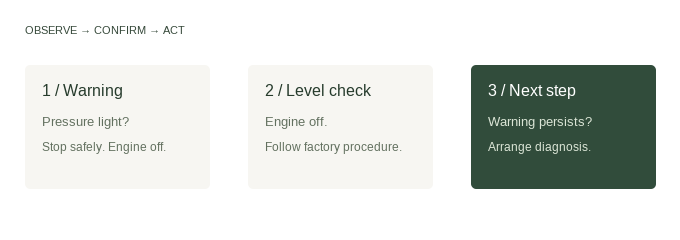
Provide a concise diagnostic history
Tell the workshop when the noise began, whether it changed with temperature, and whether the vehicle had a recent service or impact. Mention the last known normal level and any consumption history. The workshop can decide whether an independent pressure check, oil/filter inspection, or further mechanical assessment is appropriate. Ask how it will avoid unnecessary engine operation during diagnosis and request the findings before authorizing extensive work.
- Stop safely when serious noise accompanies an oil warning.
- Save the exact message and mileage.
- Do not attempt to quiet the engine with an additive.
- Use recovery when continued operation is uncertain.
Common questions
If the noise disappears after adding oil, is it fixed?
Not necessarily. The cause of the low level and any remaining lubrication or damage concerns still need assessment.
Can I drive gently to hear it better?
Avoid diagnostic driving when a lubrication problem is suspected. Arrange a controlled inspection.