Pressure warnings, new knocking, heavy rattling, seizure, or unusual metal after a low-oil event require professional assessment. Their absence does not prove that no damage occurred. Record what happened and avoid repeated running until the lubrication concern has been resolved.

Write down the event before details fade
Record the last known correct level, the first warning, any sounds, and how long the engine continued to run. Note whether it stalled, overheated, or had an active leak. Keep the service invoice and measured amount added afterward. The difference between below-minimum oil and a confirmed pressure-loss event matters. Be factual about uncertain timings; a technician can use an honest approximate history better than an invented precise one.
Understand what a top-up does and does not establish
Correct oil restores the stored quantity when low, but it does not assess bearings, timing components, turbocharger condition, or actual pressure. A quieter engine after filling is not a complete health certificate. Do not drive a long route to see whether it feels normal or use an additive to conceal noise. The workshop can decide which checks are justified and whether the engine should remain off during early inspection.
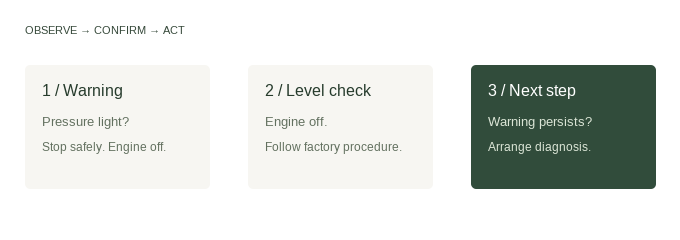
Ask for a staged assessment
Testing may include a safe pressure evaluation, oil and filter inspection, fault-code review, and further mechanical checks when evidence supports them. Request the measured findings and what each implies for repair options. Some damage questions cannot be answered by a quick scan tool check alone. Agree on authorization stages so a diagnostic inspection does not become an unexplained major repair. Resolve the source of oil loss as well as any resulting damage.
- Preserve the warning and running-time history.
- Keep the oil and filter evidence if requested.
- Do not use a top-up as proof of no damage.
- Ask for results before authorizing extensive work.
Common questions
If the engine still starts, is it undamaged?
Starting ability does not establish the condition of lubricated parts or safe operating pressure.
Can a code reader prove the engine is fine?
No. Fault-code information is only one part of a lubrication and mechanical assessment.