Oil analysis can help investigate contamination or wear trends, but it works best with a suitable sample and a clear question. A single report cannot guarantee an engine's health. Give the laboratory and repairer the oil, engine, mileage, service, and operating history needed to interpret the result.

Decide what you need to learn
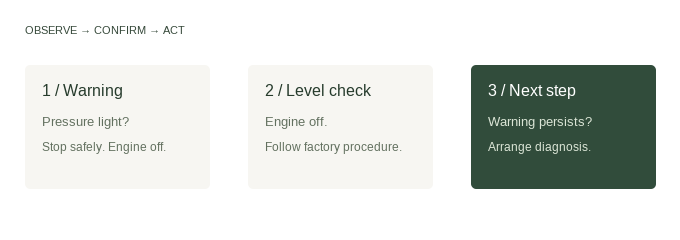
Possible questions include whether fuel or coolant contamination is present, whether viscosity has changed, or whether a repeated wear trend deserves investigation. A laboratory offers particular tests with their own limits. Ask what its standard package includes rather than assuming every possible contaminant is measured directly. Do not use a report to overrule an active pressure warning, overheating, or serious engine noise; those conditions require prompt assessment.
Collect a representative sample
Follow the selected laboratory's instructions for sampling point, container, timing, and labeling. Avoid a dirty drain pan or reused chemical bottle that could introduce misleading material. Record oil brand and specification, distance on the oil and engine, filter changes, and all top-up quantities. Note recent repairs and unusual operating conditions. If a workshop is managing a warranty or consumption test, coordinate sampling so you do not disturb its procedure.
Interpret trends with the operating context
Wear metals, viscosity, contamination indicators, and other results need engine- and oil-specific interpretation. Additive chemistry can contribute some elements, and different test methods detect different sizes or types of material. Compare like-for-like samples where possible and ask the laboratory to explain unexpected changes. A concerning report should lead to a focused inspection or repeat test as advised, not an automatic engine replacement based on a single highlighted number.
- Define the diagnostic question before ordering.
- Use the laboratory's clean sampling method.
- Report all measured top-ups and recent repairs.
- Keep comparable reports for trend review.
Write the diagnostic question before ordering a sample
Tell the laboratory what you are trying to determine: possible fuel dilution, a coolant-related concern, unusual wear debris or a trend over successive services. Record the oil product, time and mileage on the fill, total vehicle mileage, additions and recent repairs. Those details help separate a meaningful comparison from an unexplained isolated number.
Use the sampling method and container required by the chosen laboratory. Ask how contamination from a dirty drain pan, an uncertain sample point or an unrecorded top-up could affect interpretation. Mobil’s analysis overview describes different tests for different questions; it does not supply a universal passenger-car pass/fail threshold. A report should support diagnosis and maintenance decisions, not independently authorize ignoring the factory schedule or continuing to operate with a pressure warning.
Write the diagnostic question before ordering a sample
A specific contamination or trend question is identified
Choose the relevant tests and supply the complete sample history.
Sample source or container cleanliness is uncertain
Tell the laboratory before interpreting the result.
A running-engine pressure warning exists
Address safe shutdown and diagnosis first; waiting for analysis is not a driving clearance.
Common questions
Can analysis tell me exactly which part failed?
It can provide clues, but mechanical inspection and other tests may be needed to locate the source.
Can I extend the oil interval from one good report?
Follow manufacturer requirements and a properly interpreted program; one report is not universal permission.
