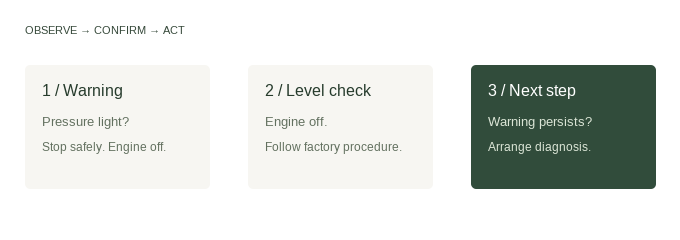
A pressure warning that appears only at idle still needs a safe shutdown and diagnosis. Its disappearance when engine speed rises does not prove the system is healthy. Check the oil level after stopping, then obtain an engine-specific assessment of pressure, oil condition, and the warning circuit.

Record the conditions without repeating them
Note whether the engine was fully warm, the air conditioning was operating, the car had just left a highway, or a recent service preceded the warning. Record the exact symbol or message. Do not sit idling to reproduce the light and do not keep the revs up to keep it off. If the warning appears while running, stop safely and turn the engine off rather than trying to finish the journey.
Check the basic facts after shutdown
Use the manual's level-check procedure and verify the installed oil specification from the service invoice or bottle. Inspect accessible areas for a leak and note any new noise. Low level, unsuitable oil, filter issues, mechanical wear, supply restrictions, and sensor faults can each enter the investigation, but the pattern alone cannot choose among them. Avoid adding a thickener or changing viscosity to suppress the symptom before testing.
Ask for a measured diagnosis
The workshop may compare actual pressure against the exact engine's specified conditions and inspect the electrical indication when appropriate. Ask for the measured value, oil temperature or test conditions, and the source of the specification. A dashboard gauge or code reader alone may not answer the pressure question. Once repaired, the original hot-idle condition should be checked through an appropriate controlled process, not an unplanned road test with a warning active.
- Keep the warning text and temperature context.
- Do not use extra throttle as a workaround.
- Verify oil and filter details from the last service.
- Arrange recovery for an unresolved pressure concern.
Common questions
Can I drive if the light goes out above idle?
That does not establish safe pressure in all conditions. An unresolved running-engine warning needs assessment.
Is it always a worn engine?
No. A proper test must distinguish mechanical supply issues from oil, filter, and indication faults.