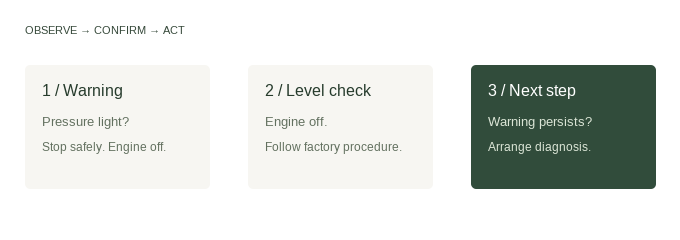
Oil use in a turbocharged engine does not automatically mean the turbocharger must be replaced. First confirm the level trend and check external leaks, ventilation, oil supply and return arrangements, and other engine evidence. Heavy smoke or a pressure warning needs prompt shutdown and assessment.

Build the same reliable baseline
Use the exact required oil and manual-specified level-check procedure. Record mileage, measured top-ups, operating conditions, and recent repairs. Note whether smoke appears during start-up, ordinary acceleration, or after idling, but do not perform hard acceleration tests to reproduce it. Tell the workshop about fault codes, unusual turbo noise, and changes in performance. Those observations help select inspections; they do not identify a seal by themselves.
Ask what supports the proposed repair
Request the documented findings and the checks that ruled out other causes before authorizing an expensive assembly. If a component is replaced, the repair plan should address any related cause and manufacturer requirements so the problem does not recur. Keep oil-service records and the measured consumption trend. Do not mask symptoms with an unapproved additive or viscosity change while a warranty or formal consumption test is being arranged.
- Record oil use and operating conditions.
- Report recent intake or engine work.
- Ask for evidence beyond visible hose residue.
- Treat heavy smoke and pressure warnings urgently.
Common questions
Does oil in the intake prove a bad turbo?
No. Its amount, location, ventilation arrangement, and the wider diagnosis matter.
Can a turbo engine be driven low on oil?
Do not operate below the permitted range. A pressure warning requires a safe stop and engine shutdown.