Identify the washer reservoir, choose fluid with the required compatibility and cold-weather protection, and add it through the washer fill opening without contaminating other systems.

Find the correct reservoir and product
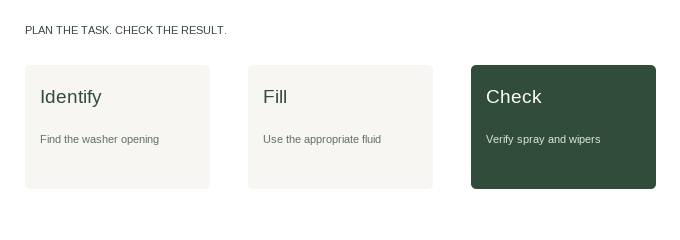
Use the windshield-spray symbol and the vehicle’s underhood diagram to identify the washer fill opening. Coolant, brake fluid and washer fluid are different systems even when their containers are close together. Read the product label before pouring and keep the container’s nozzle clean.
Choose fluid suited to expected temperatures and any vehicle restrictions on additives or treatments. A summer cleaning product is not automatically protected against winter freezing. Ready-to-use fluid and concentrate require different handling, so use the actual mixing directions rather than assuming every bottle is poured in undiluted.
Fill carefully and check the spray
Work with the vehicle parked and the relevant components in a safe state. Remove the washer cap, add the suitable fluid without overflowing and reinstall the cap. Ford’s 2025 Maverick instructions use this basic fill sequence while referring to its own fluid specification. Other vehicles can have different access arrangements.
After filling, check washer operation where the spray will not obstruct people or other traffic. Observe whether the spray reaches the glass and whether the wipers clear it. Clean glass and good blades matter too; increasing fluid strength will not repair torn blades or a blocked mechanical path.
Separate an empty bottle from a system fault
If the reservoir empties quickly, note visible wet areas and whether leakage happens while parked or only when the pump operates. If fluid is present but spray is absent, stop repeatedly running the pump and investigate the supported troubleshooting path. A frozen system needs thawing and assessment, not forceful pumping.
Do not add engine coolant, dish detergent or an improvised mixture because the washer fluid has run out. Store the correct labeled product securely and keep it away from children and pets. Record the seasonal product and any dilution so a later cold-weather problem can be traced to what was actually installed.
Before pouring washer fluid
| Check | Action |
|---|---|
| Reservoir identified | Use the windshield-spray fill opening |
| Weather rating | Choose protection for expected cold |
| Concentrate or ready-to-use | Follow the actual mixing directions |
| Rapid fluid loss | Investigate leakage rather than only refilling |
Common questions
Can water replace winter washer fluid?
Water alone does not provide the cold-weather protection of a correctly selected washer product. Choose for the temperatures the vehicle will encounter.
What if I put washer fluid into another reservoir?
Stop before operating the affected system and obtain application-specific advice. Do not try to correct the mix by adding more of the other fluid.

