Dark oil alone does not show that an engine is damaged or that the oil has reached a universal change point. Oil color changes with operation and contamination handling. Follow the specified schedule and investigate abnormal texture, particles, rising or falling level, and warning signs separately.

Separate appearance from service history
Note the exact oil-change date, mileage, engine type, and oil specification before judging the color. Fresh oil can darken after mixing with retained oil and carrying material from the engine. Diesel and gasoline engines can present differently. A photograph taken in a shadow or on a stained dipstick can exaggerate darkness. Do not reset the service interval or extend it merely because the oil looks clean.
Look for changes that carry more information
Grit, obvious metal, milky material, an unusual level trend, persistent fuel odor, or thick deposits need a more focused assessment than color alone. Check for warning messages and changes in engine behavior. Never rub used oil between bare fingers as an improvised laboratory test. If you are concerned, an appropriate sample and service history provide a laboratory or technician with more useful evidence than a color comparison chart.
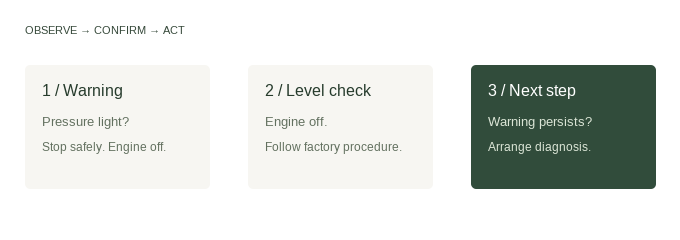
Choose maintenance based on the right criteria
Use the vehicle's time, distance, oil-life, and severe-service instructions together as applicable. If the maintenance history is unknown, establish a suitable baseline with the correct product and record the service. A mechanic can inspect for deposits or contamination when the evidence warrants it. Avoid aggressive flushing just to make the oil appear lighter; appearance is not the objective of a healthy maintenance routine.
- Record actual service date and mileage.
- Compare level under the same conditions.
- Investigate visible particles or contamination.
- Use analysis for a defined question, not color alone.
Compare appearance with service history and other observations
A useful record pairs an oil photograph with the date, odometer reading, distance on the fill and recent oil additions. A dark sample viewed in a deep container can look different from a thin film on a dipstick. Keep lighting and sample presentation reasonably consistent if you are comparing your own observations over time.
Color does not supply a measured viscosity, contamination concentration or remaining service life. Continue to use the applicable schedule or oil-life system, while investigating separate signs such as a rising level, unusual debris, coolant loss or pressure warnings. If laboratory analysis is requested, give the laboratory the exact oil and service history. An unremarkable appearance should not override a warning, and dark appearance alone should not be converted into a diagnosis or a new universal change interval.
Compare appearance with service history and other observations
Oil is darker but no other finding is documented
Record service history and follow the applicable schedule; color alone is incomplete evidence.
Darkness accompanies a changing level or other contamination clue
Investigate the additional observation with an application-specific question.
Pressure warning or abnormal engine noise appears
Stop safely; appearance cannot establish safe lubrication.
Common questions
Should I change oil as soon as it looks black?
Color by itself is not a reliable service interval. Follow the manual and assess other symptoms.
Does clear oil mean it is still good?
No. An apparently clean sample does not establish that the oil meets its service-life requirements.